


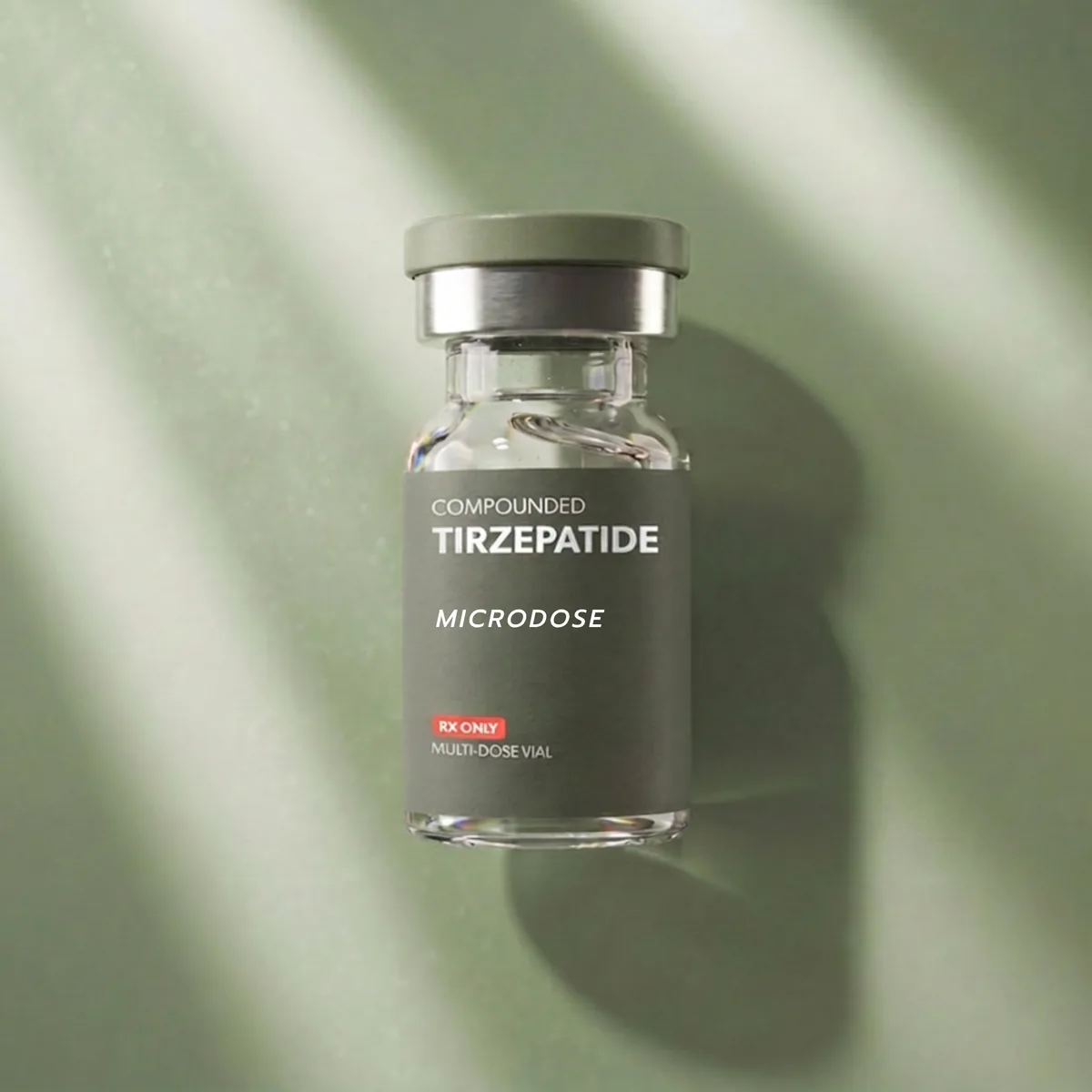
Compounded Microdose Tirzepatide
Provider-guided compounded microdose tirzepatide — a once-weekly dual GLP-1/GIP injection at a fraction of the standard dose, offered for metabolic support as part of a longevity plan rather than for weight loss.
-
 Metabolic support as part of a longevity plan, not a weight-loss program
 -
 Dual GLP-1 and GIP signaling, once weekly at a low dose
 -
 A steady dose your provider sets — no titration ladder
 No charge if not eligible
 Provider-guided care
No commitment until eligibility review is complete.
What is Compounded Microdose Tirzepatide?

Tirzepatide is a dual agonist: it acts on both the GLP-1 and the GIP receptor, two gut hormone pathways involved in blood sugar regulation, digestion, and appetite signaling.1
A microdose protocol uses a fraction of the dose prescribed for weight management, held steady rather than stepped up. The goal is different too: compounded microdose tirzepatide in this program is offered for metabolic support as part of a longevity plan — it may support metabolic balance, steadier energy, mental clarity, and a calmer relationship with appetite. It is not offered as a weight-loss treatment, and Raeliva makes no weight-loss claim for it.
Compounded Microdose Tirzepatide is a compounded medication: it is prepared by an appropriately licensed pharmacy or outsourcing facility against a prescription from a licensed provider, rather than dispensed as an FDA-approved finished product. Compounded medications are not FDA-approved and are not reviewed by the FDA for safety, effectiveness, or quality before they are dispensed.2
Microdosing is not an FDA-approved dosing regimen. The clinical trials behind the approved GLP-1 medications studied standard therapeutic doses, not the lower doses used here, so the evidence for microdosing specifically is limited and largely observational. What is well established is the underlying pharmacology and the safety information below, which your provider reviews with you before prescribing.
Tirzepatide is a GIP receptor and GLP-1 receptor agonist — it activates both.1 GIP and GLP-1 are two separate incretin hormones, each released from the gut after eating and each with its own receptor. A GLP-1 receptor agonist acts on one of them. Tirzepatide acts on both, which is what "dual agonist" means.
Structurally it is built on the GIP side rather than the GLP-1 side: a 39-amino-acid modified peptide based on the native GIP sequence, carrying a fatty diacid chain that binds albumin and slows clearance. That modification is what makes once-weekly dosing possible.1
Through those two receptors, the approved labeling describes glucose-dependent insulin secretion — insulin released in response to what you have eaten rather than on a schedule — reduced glucagon, delayed gastric emptying, and action on receptors in regions of the brain involved in appetite regulation.1
Two pathways is not a claim that it works better at a microdose, and we are not going to imply it. No study has compared the two molecules at these doses; the trials behind both approved products used standard therapeutic doses. A dual agonist may be the right choice for you, but that is your provider reading your history — not a specification advantage you can read off this page.
As with the other molecule in this program, the pharmacology above belongs to tirzepatide and does not change because the dose is lower. What the labeling does not cover is the regimen — a low dose held steady instead of escalated — which is why the evidence note above says what it says.
A microdose protocol is not a substitute for sleep, food, hydration, movement, or regular medical care, and it is not a shortcut around any of them. Your provider looks at the full picture — health history, medications and supplements, labs, sleep, and daily routine — before recommending anything.
Two groups, mainly. Adults who want clinician-guided metabolic support as part of a longevity plan, without a weight-loss focus. And adults already stabilized on a standard GLP-1 dose who want to step down to a lower maintenance dose — a decision that belongs with the provider managing your treatment, not with a website.
Compounded Microdose Tirzepatide is not right for everyone. It is not appropriate for people with a personal or family history of medullary thyroid carcinoma or MEN 2, and people who are pregnant or nursing, or who have a history of pancreatitis or certain other conditions, may not be candidates.1 The provider screening checks for this, so share your full health history during intake. If treatment is not right for you, there is nothing to pay.
Your monthly price includes provider review, prescription management when appropriate, medication, refill coordination, shipping, and ongoing support. Lab work, when required, may be billed separately unless otherwise stated.
- Online consultation From the comfort of your home, no in-person appointments needed.
- Your prescription A licensed provider reviews your answers and labs, then prescribes treatment if it is appropriate. If you're not suitable, there's nothing to pay.
- Your medication Raeliva includes the full cost of your medication in your monthly price.
- Shipping Your medication ships in discreet, temperature-appropriate packaging.
- Ongoing care and support Check-ins, dosing guidance, plain-language education, and refill coordination.
One subcutaneous injection per week, any day, with or without meals.1 Unlike a weight-management protocol, a microdose is not titrated upward toward a target dose — your provider sets a low dose and the point is to hold it there. If it needs adjusting, that comes out of a check-in, not a schedule.
- Once-weekly injection Compounded Microdose Tirzepatide is taken as a subcutaneous injection one time per week, any day, with or without meals.1
- A steady low dose Your provider sets your dose and reviews it at check-ins. There is no escalation ladder to climb, and no dose change without your provider.
- Rotate injection sites Rotate between thigh, abdomen, and upper arm to reduce site reactions and discomfort.
- Missed dose guidance Missed-dose instructions depend on the medication you are prescribed. Do not take two doses at once. If you miss a dose, follow the instructions provided with your prescription or message your care team before dosing. Your provider can tell you whether to take the missed dose, skip it, or adjust your schedule based on your specific medication and timing.
Side effects are possible at any dose, and we will be straight about them. The most commonly reported are gastrointestinal — nausea, constipation, diarrhea, and digestive discomfort.1 Those effects are dose-related, which is why the approved labeling escalates the dose gradually to improve gastrointestinal tolerability;1 a protocol that stays at a low dose is starting from the gentler end of that same range. That is a reason people choose a microdose protocol, not a guarantee about how you personally will feel.
- Most common Nausea, constipation, diarrhea, and other digestive discomfort, most noticeable in the early weeks.1
- When to contact your provider Severe abdominal pain, signs of an allergic reaction, vision changes, or persistent vomiting require immediate provider contact.
- Not for everyone Compounded Microdose Tirzepatide is not appropriate for people with a personal or family history of medullary thyroid carcinoma or MEN 2.1
- Serious risks still apply A lower dose does not remove the risks described in the approved labeling for this molecule, including thyroid C-cell tumors, pancreatitis, and gallbladder disease.1 Your provider reviews the full picture with you before you start.
Your medication ships in refrigerated packaging and needs to stay cold between doses.
- Refrigeration Store at 36–46°F (2–8°C) in the original carton. Keep the medication in the refrigerator between doses.1
- Protect from light Keep in the original packaging until use to protect the medication from light exposure.
- Do not freeze If your medication freezes or is exposed to extreme heat, discard it and contact our team for a replacement.
- Travel guidance Medication is stable at room temperature for limited periods during travel. Use an insulated cooler for longer trips.
-
Weekly injection
Once per week, self-administered at home
-
A steady low dose
Provider-set, held steady — no titration ladder
-

Medication included
Full cost of your medication in the monthly price
-
Ongoing support
Check-ins, education, and coordinated refills
Your simple 4-step plan
-
 Step 1
 Answer a few questions
Share your goals and health history in a short online intake so a licensed provider can review them properly. No appointment needed.
-
 Step 2
 A provider reviews your file
A licensed provider checks your eligibility and prescribes only if treatment is right for you. If it is not, there is nothing to pay.
-
 Step 3
 Your medication ships to you
Delivered in discreet, refrigerated packaging with clear instructions for safe use — usually overnight.
-
 Step 4
 Ongoing check-ins and refills
Message the clinical team whenever you need to. Check-ins, dosing guidance, and refill timing are coordinated for you.
Trusted by patients looking for clearer care
- Provider-guided treatment
- Transparent pricing
- No hidden fees
- Support that does not disappear after checkout
Learn More About Compounded Microdose Tirzepatide
What is compounded microdose tirzepatide used for?
How is a microdose different from a standard GLP-1 dose?
Is microdosing FDA-approved?
What is GIP, and why does it matter here?
Does acting on two pathways make it better than microdose semaglutide?
Is tirzepatide the same as Mounjaro or Zepbound?
Will I lose weight on a microdose protocol?
I am already on a GLP-1. Can I switch to a microdose?
Are there side effects?
How is it taken?
How fast will I notice changes?
What is included in the monthly price?
Is this covered by insurance?
How do refills work?
What support do I get during the program?
What if I miss a dose?
Who is eligible for Compounded Microdose Tirzepatide?
Will I need lab work?
How is my medication shipped?
Do you ship to all US states?
What about international shipping?
Is this a compounded medication?
Is this billed monthly or upfront?
Does my price go up after my first order?
Do you take insurance, FSA, or HSA?
How do I refill or reorder?
How do I cancel?
Sources
Clinical content and references last reviewed August 11, 2026.
The mechanism, contraindication, and side effect information on this page is drawn from the FDA-approved labeling for FDA-approved medications in this drug class. Those are different products, made by different manufacturers, and their FDA approval does not apply to a compounded preparation. That labeling also covers standard therapeutic doses, not the lower doses used in a microdose protocol, and microdosing is not an FDA-approved dosing regimen. Compounded medications are not FDA-approved; the FDA does not review them for safety or effectiveness before they are dispensed, and no compounded medication has been shown to be equivalent to an approved product. These references are provided for general education about the drug class, not as evidence about the medication in this program.
- 1.ZEPBOUND (tirzepatide) injection, for subcutaneous use. Prescribing information. Eli Lilly and Company. — FDA label via DailyMed
- 2.US Food and Drug Administration. Compounding and the FDA: Questions and Answers. — FDA
These references are provided for education. They are not an endorsement of Raeliva by any author, journal, or agency, and they do not replace the guidance of the licensed provider who reviews your health history.
Disclaimer
Only available if prescribed after an online consultation with a licensed healthcare provider. Information provided is based on third-party studies. Plans are offered as a subscription service, which can be canceled at any time. Actual product packaging may appear differently than shown. Providers may prescribe compounded medications as needed to meet patient requirements. The FDA does not review or approve compounded medications for safety or effectiveness. Compounded medications are not FDA-approved and are not the same as brand-name products. The statements on this page have not been evaluated by the FDA. Results may vary. If you notice any side effects while using this treatment, contact your licensed healthcare provider. For severe or urgent symptoms, seek medical care right away. If you are experiencing a medical emergency, call 911.